The Enduring Legacy of C
Why Half a Century Later, We Still Can't Live Without It
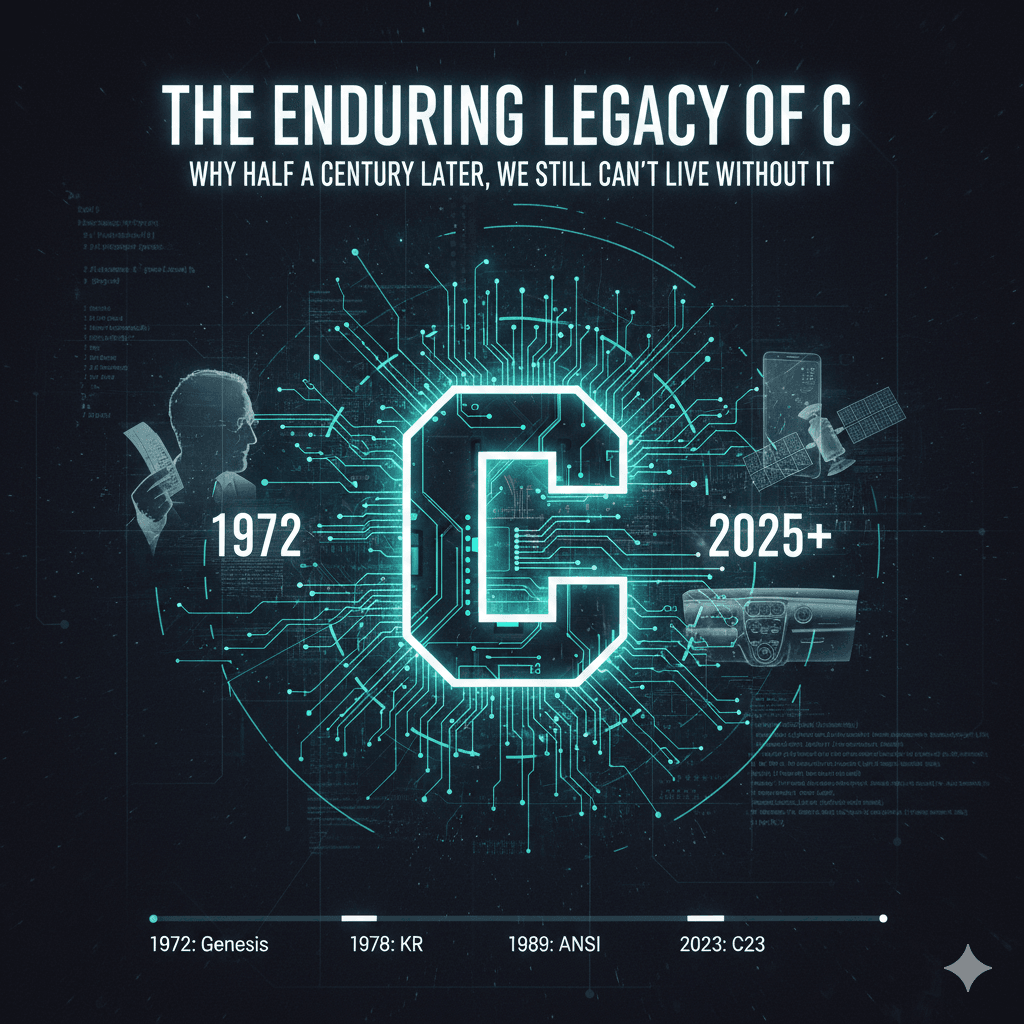
In the gleaming corridors of Bell Labs in 1972, a young computer scientist named Dennis Ritchie was quietly crafting something revolutionary. He couldn't have known that his creation the C programming language would become the invisible foundation upon which the entire digital world would be built. More than fifty years later, C remains not just relevant but indispensable, powering everything from the smartphone in your pocket to the aircraft soaring overhead.
The Genesis: From BCPL to C
Ken Thompson creates B language, derived from Martin Richards's BCPL
Dennis Ritchie transforms B into C, adding data types and modern syntax
The most creative period - C takes its modern form
Unix kernel rewritten in C, proving the concept of OS development in high-level language
Kernighan & Ritchie publish "The C Programming Language" (K&R)
ANSI standardizes C (C89/C90)
C23 standard introduces modern features while maintaining backward compatibility
The story of C begins between 1969 and 1973, evolving alongside the nascent Unix operating system, with its most creative period occurring during 1972. Dennis Ritchie began modifying B (created by his colleague Ken Thompson), adding data types and syntax characteristics that transformed it into C by 1972.
Derived from the typeless language BCPL by Martin Richards, C evolved to include a type structure. What started as a tool to improve a limited programming environment on a tiny machine grew into one of the dominant languages of computing.
C's design was based on Ritchie's experience with high-level languages for Multics implementation, but was significantly reduced in size because computers of that era had very limited capacity there simply wasn't enough memory or processing power to support large compilers for complex languages. This enforced minimality became one of C's greatest strengths.
C Language Architecture: The Foundation of Modern Computing
C Language Architecture - Layer Model
Why C is Architecturally Superior
Minimal Abstraction
C provides just enough abstraction from assembly language to be portable, while staying close enough to hardware for maximum performance. This sweet spot makes C ideal for systems programming.
Direct Memory Control
Unlike higher-level languages, C gives programmers complete control over memory allocation and deallocation. This enables optimization that's impossible in garbage-collected languages.
Hardware Access
C can manipulate arbitrary memory addresses, read/write hardware registers, and use inline assembly when needed. This makes it indispensable for device drivers and embedded systems.
C in Embedded Systems: Architecture Deep Dive
Embedded System Architecture with C
Automotive ECUs
Engine control, ABS, airbag systems, infotainment. C provides deterministic timing crucial for safety-critical operations.
IoT Devices
Smart home sensors, thermostats, security systems. Minimal memory footprint allows C to run on resource-constrained devices.
Medical Devices
Pacemakers, insulin pumps, monitoring equipment. C's reliability and real-time capabilities are life-critical.
Avionics
Flight control systems, navigation, autopilot. Meets DO-178C certification requirements for aviation software.
Industrial Control
PLCs, robotics, factory automation. Precise timing control for coordinated machinery.
Communication
Routers, switches, modems, cellular base stations. Handles high-speed packet processing efficiently.
Operating System Architecture: C at the Core
Operating System Kernel Architecture (Linux Example)
The Linux kernel is written mostly in C as supported by the GNU Compiler Collection (GCC), which includes extensions beyond standard C, with some assembly code for architecture-specific optimizations. C made it possible to undertake something never done successfully before: write an entire operating system in a high-level language.
By 1973, Unix had been converted from its original assembly language into C, making it much easier to maintain and modify the system. C became the foundation for Unix's portability it was no longer necessary to translate the entire operating system for each new computer's assembly language by hand.
Why C Remains Unbeatable in 2025
| Feature | C Language | Why It Matters |
|---|---|---|
| Performance | Near-assembly speed Zero overhead | Critical for OS kernels, real-time systems, HFT algorithms |
| Memory Control | Manual allocation Pointer arithmetic | Embedded systems with KB of RAM, precise resource management |
| Hardware Access | Memory-mapped I/O Register manipulation | Device drivers, firmware, hardware initialization |
| Portability | Cross-platform Standard compliance | Write once, compile anywhere - from MCU to supercomputer |
| Predictability | Deterministic No GC pauses | Real-time systems, aviation, medical devices requiring guaranteed response times |
| Ecosystem | 50+ years Billions of LOC | Massive existing codebase, proven libraries, extensive tooling |
What Can You Build With C?
#define UART_BASE_ADDR  0x40013800
#define UART_DR         (*(volatile uint32_t *)(UART_BASE_ADDR + 0x04))
#define UART_SR         (*(volatile uint32_t *)(UART_BASE_ADDR + 0x00))

void uart_send_char(char c) {
    // Wait until transmit data register is empty
    while (!(UART_SR & (1 << 7)));

    // Write character to data register
    UART_DR = c;
}

// This direct hardware manipulation is C's superpower
// No abstraction, maximum control, predictable timingstruct task_struct {
volatile long state; // -1 unrunnable, 0 runnable, >0 stopped
void *stack;
atomic_t usage;
unsigned int flags;
int prio;
// ... thousands more fields
};
// Direct memory management, no runtime overhead
static inline struct task_struct *get_current(void) {
return current_thread_info()->task;
}Modern C Development: Tools & Practices
Development Tools
- Compilers: GCC, Clang/LLVM, MSVC with advanced optimizations
- Debuggers: GDB, LLDB, rr (record & replay), Valgrind for memory analysis
- Build Systems: Make, CMake, Meson for complex project management
- Static Analysis: Clang Static Analyzer, Coverity, Cppcheck for code quality
Standard Library Power
The C standard library provides macros, type definitions, and functions for string manipulation, mathematical computation, I/O processing, and memory management. On Unix-like systems, the C library is considered part of the operating system and cannot be erased without breaking system functionality.
Studies indicate that applications utilizing standard library functions can see performance boosts of up to 30% compared to custom implementations. These functions have been rigorously tested and optimized over decades.
Real-World Impact: Projects Powered by C
The list of influential software written in C reads like a who's who of computing infrastructure. PostgreSQL, a powerful object-relational database system, has most built-in functions written in C, as functions written in C offer the best performance. Redis, the popular in-memory key-value database, was initially prototyped in Tcl but the final product was rewritten in C for performance.
SQLite, a lightweight database engine used in countless applications from mobile apps to embedded devices, is implemented in C, with its compact size, reliability, and speed stemming from C's efficient memory use and direct control over database file formats. The reference implementations of Python, Perl, Ruby, and PHP are all written in C.
The Learning Curve: Why C Makes Better Programmers
Learning C is admittedly challenging. Programming in C requires a defensive programmer's mindset since the language allows doing anything with the computer, meaning developers can break everything if not cautious. Yet this challenge creates exceptional developers.
The discipline required by C's minimal abstractions encourages developers to deeply understand underlying hardware and memory management concepts, which higher-level languages often obscure. Learning C first gives foundational knowledge that makes you a better programmer in any language.
The C Programming Skillset
The Future: C in 2025 and Beyond
Far from being a relic, C continues evolving. C23 is the latest major C language standard revision, introducing 14 new keywords and modern features including arbitrary-width integers via `_BitInt`, the `#embed` preprocessor directive for including binary data, and improved developer experience while maintaining C's core strengths.
C23 New Features
_BitInt(N)Arbitrary-width integers for hardware registers
#embedDirect binary file inclusion (images, fonts, certificates)
typeofType inference and generic programming
constexprCompile-time evaluation
[[attributes]]Modern syntax for compiler hints
Binary literals0b prefix for bit patterns
C remains a cornerstone of the software world in 2025, with operating system kernels, modern compilers and interpreters choosing C as an implementation vehicle, leveraging its ability to produce efficient, portable executables serving as a widely accepted lowest common denominator on diverse platforms.
The enormous amount of existing code written in C, combined with performance demands where every cycle counts, ensures C's continued relevance. As hardware continues evolving, the need for efficient programming will only increase, with the ever-growing landscape of embedded systems and IoT heavily relying on C.
Conclusion: The Invisible Infrastructure
The next time you make a phone call, browse the web, drive a car, or board an airplane, remember: you're trusting your life to C code. The world is running on C-powered devices that we use every day whether we realize it or not.
C is quirky, flawed, and an enormous success. While accidents of history surely helped, C evidently satisfied a need for a system implementation language efficient enough to displace assembly language, yet sufficiently abstract and fluent to describe algorithms and interactions in a wide variety of environments.
C's Domain: From Atoms to Galaxies
From the depths of operating system kernels to the heights of spacecraft software, from the microscopic world of embedded processors to the massive scale of supercomputer clusters, C remains the common thread. It is simultaneously the language of the past, present, and future a testament to the genius of Dennis Ritchie's elegant design.
"C is the past, the present, and as far as we can see, still the future for many areas of software."
In an industry obsessed with the new and shiny, C's enduring dominance proves that sometimes, the old ways are simply the best ways. The language that Unix built continues building our digital world, one perfectly optimized line at a time.