From Coaxial to Fiber
The Evolution of Broadband Infrastructure and the Quest for Better Alternatives
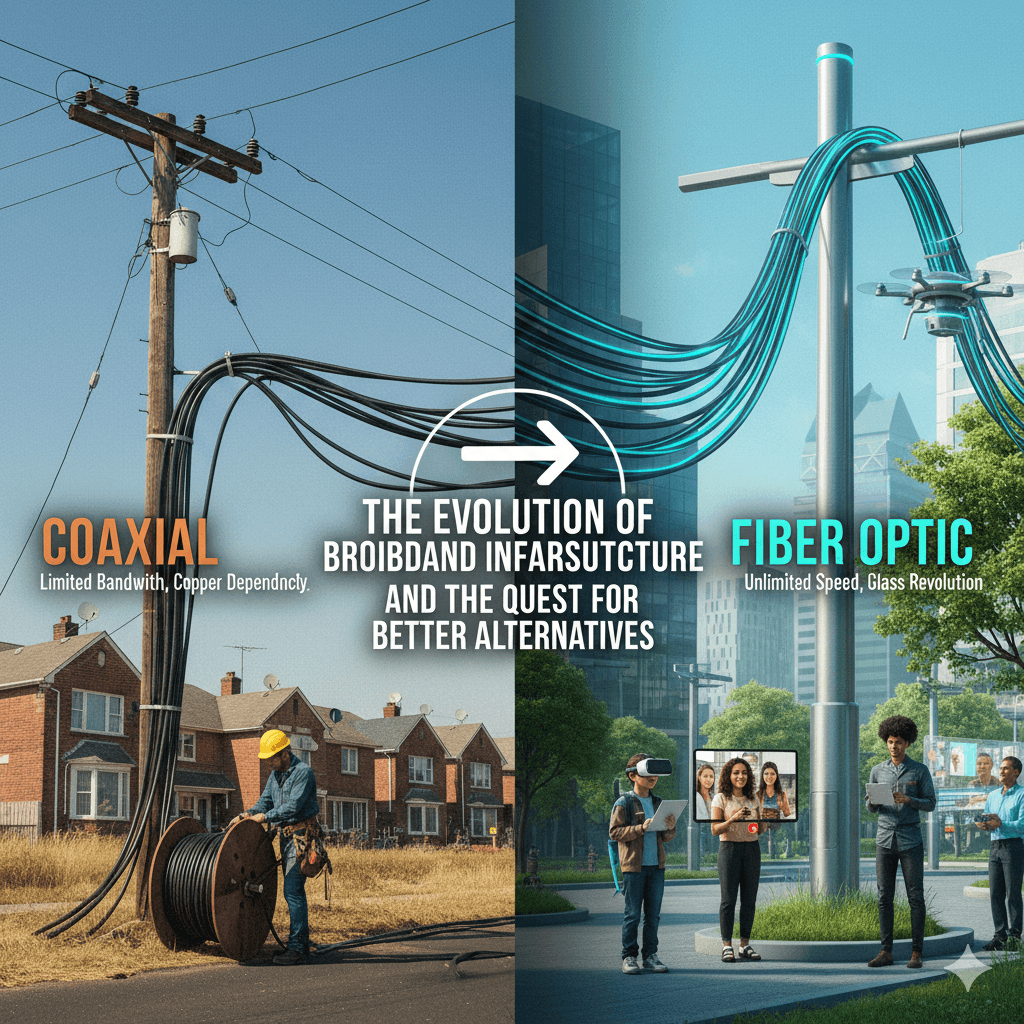
Your home internet connection has undergone a remarkable transformation over the past three decades. What began as a simple coaxial cable carrying television signals has evolved into a sophisticated hybrid fiber-coax network, and increasingly, pure fiber-to-the-home deployments. Yet despite fiber optics' dominance in modern telecommunications, the technology carries inherent limitations that have researchers exploring alternatives. This deep dive explores the technical evolution from coaxial to fiber, examines the surprising resiliency of copper-based systems, and investigates cutting-edge alternatives that might define the next generation of broadband.
Part 1: The Coaxial Foundation
Coaxial cable, invented in 1880 and patented by Oliver Heaviside, became the backbone of cable television networks throughout the latter half of the 20th century. The basic architecture is elegantly simple yet highly effective for its purpose.
Coaxial Cable Cross-Section
The genius of coaxial cable lies in its electromagnetic shielding. The outer conductor acts as both a return path and an electromagnetic shield, protecting the inner conductor from external interference. This design allows coaxial cables to carry high-frequency signals over longer distances than twisted-pair wiring could manage.
The Hybrid Fiber-Coax Revolution
Hybrid Fiber-Coax Network Topology
This architecture proved remarkably successful. By the early 2000s, HFC networks were delivering broadband speeds that embarrassed incumbent telephone companies still relying on DSL over copper telephone lines. The key innovation was pushing fiber deeper into the network, reducing the distance that signals traveled over lossy coaxial cable.
DOCSIS: The Cable Modem Standard
| Standard | Year | Downstream | Upstream | Key Feature |
|---|---|---|---|---|
| DOCSIS 1.0 | 1997 | 40 Mbps | 10 Mbps | Basic cable internet |
| DOCSIS 2.0 | 2001 | 40 Mbps | 30 Mbps | Improved upstream |
| DOCSIS 3.0 | 2006 | 1 Gbps | 200 Mbps | Channel bonding |
| DOCSIS 3.1 | 2013 | 10 Gbps | 1-2 Gbps | OFDM modulation |
| DOCSIS 4.0 | 2023 | 10 Gbps | 6 Gbps | Full-duplex, extended spectrum to 1.8 GHz |
The progression reveals an interesting asymmetry. Downstream speeds improved dramatically while upstream speeds lagged behind—a reflection of the original cable TV architecture's one-way design philosophy. DOCSIS 4.0 finally addresses this limitation with Full-Duplex DOCSIS (FDX) and Extended Spectrum DOCSIS (ESD) options.
Part 2: The Fiber Optic Transformation
Fiber Optic Cable Structure
The physics behind fiber optics relies on total internal reflection. The core has a slightly higher refractive index than the cladding (1.47 vs 1.46), causing light to reflect at the boundary rather than escape. This allows light signals to travel vast distances with minimal loss—modern single-mode fibers achieve attenuation as low as 0.15 dB/km at 1550nm wavelength.
Finland's Fiber Deployment
Finland has emerged as a European leader in fiber optic deployment. As of September 2024, Finland's fiber-optic broadband network reaches nearly 2 million homes—68% of Finnish households. This represents a 7 percentage-point increase over a single year, demonstrating aggressive expansion.
Part 3: The Hidden Cost of Fiber
Critical Limitation: Fragility
Fiber optic cables made of glass are much more fragile than copper cables. The glass fibers can break if bent too sharply (typically bend radius <15x cable diameter) or subjected to excessive pressure during installation or construction activities.
Splicing Complexity
Fusion splicing machines cost $3,000-$30,000 vs $50-$200 for copper tools
Cleaning Requirements
Professional cleaning equipment and training required for connector cleanliness
Specialized Testing
OTDR equipment costs $5,000-$50,000 vs $100-$500 for copper testers
Environmental Sensitivity
Affected by hydrogen gas, chemicals, extreme temperatures, and moisture
Part 4: The Case for Copper's Resilience
DOCSIS 4.0 Full-Duplex Operation
| Technology | Cost per Passing | Deployment Time | Infrastructure |
|---|---|---|---|
| DOCSIS 4.0 Upgrade | $100-$200 | Software + node upgrades | Builds on existing |
| Fiber to Home | $500-$1,400 | Complete new installation | All-new infrastructure |
The economics are compelling. Comcast reported that upgrading to DOCSIS 4.0 costs under $200 per passing—a fraction of fiber deployment costs. This cost advantage is why cable operators aren't rushing to abandon their HFC networks.
Part 5: Beyond Fiber—The Quest for Better Alternatives
Hollow-Core Photonic Crystal Fiber
Light travels through air instead of glass
Recent breakthroughs have been dramatic. In 2020, researchers at the University of Southampton published results showing hollow-core fibers with attenuation lower than solid-core fibers at multiple wavelengths—0.28 dB/km in the C and L telecommunication bands.
Conclusion: There Is No Silver Bullet
Fiber optics dominates long-distance and high-bandwidth applications because light in glass offers unmatched bandwidth-distance product. But fragility, installation complexity, and cost limit its universal deployment.
Coaxial and copper systems excel in durability, ease of installation, and leveraging existing infrastructure. But fundamental electromagnetic limits cap their bandwidth and distance.
Hollow-core fiber could theoretically combine the best of both worlds—but manufacturing challenges and cost make it impractical for mass deployment in the 2020s.
The quest for a cable "more durable and faster" than fiber at lower cost faces insurmountable physics. Speed is bounded by the speed of light in the medium—fiber already approaches this limit. Durability favors copper, but at severe bandwidth sacrifice. Cost favors leveraging existing infrastructure, which means HFC/DOCSIS for much of the world.
Perhaps the real innovation isn't finding a single technology to replace fiber, but rather building intelligent hybrid networks that dynamically select the optimal technology for each segment.
References & Further Reading
Fiber Optics Research:
- • Jasion et al., "Hollow Core NANF with 0.28 dB/km Attenuation in the C and L Bands," OFC 2020
- • Debord et al., "Ultralow transmission loss in inhibited-coupling guiding hollow fibers," Optica, Vol. 4, 2017
- • Nature Communications, "Hollow core optical fibres with comparable attenuation to silica fibres," 2020
Network Infrastructure:
- • Traficom, "Fibre optic connections available to nearly 2 million households," 2024
- • CableLabs, "DOCSIS 4.0 Technology Specifications," 2023
- • IEEE Spectrum, "When Copper Broadband Beats Fiber Optics," 2022