Why Your Tap-to-Pay Card Is Way Smarter Than You Think
I was grabbing coffee last week when the person behind me asked the barista if contactless payment was "safe." The barista shrugged. The person paid with cash instead.
That got me thinking most of us use tap-to-pay every single day, but hardly anyone understands what's actually protecting their money. So I went down a rabbit hole, and what I found was honestly pretty mind-blowing.
The Question Everyone's Asking (But Nobody's Answering)
Here's what people worry about: when you wave your card near a reader, you're literally broadcasting payment data through the air. Can't someone with the right equipment just... catch it? And if they record enough of these transactions, couldn't they figure out the pattern?
Turns out, this exact scenario has been studied extensively by security researchers. The answer is fascinating, and it's not what most people think.
It's Not Encryption (And That's the Whole Point)
Most people assume tap-to-pay works like this: your card number gets encrypted, sent to the terminal, then decrypted. Like putting something in a locked box.
That's not what happens at all.
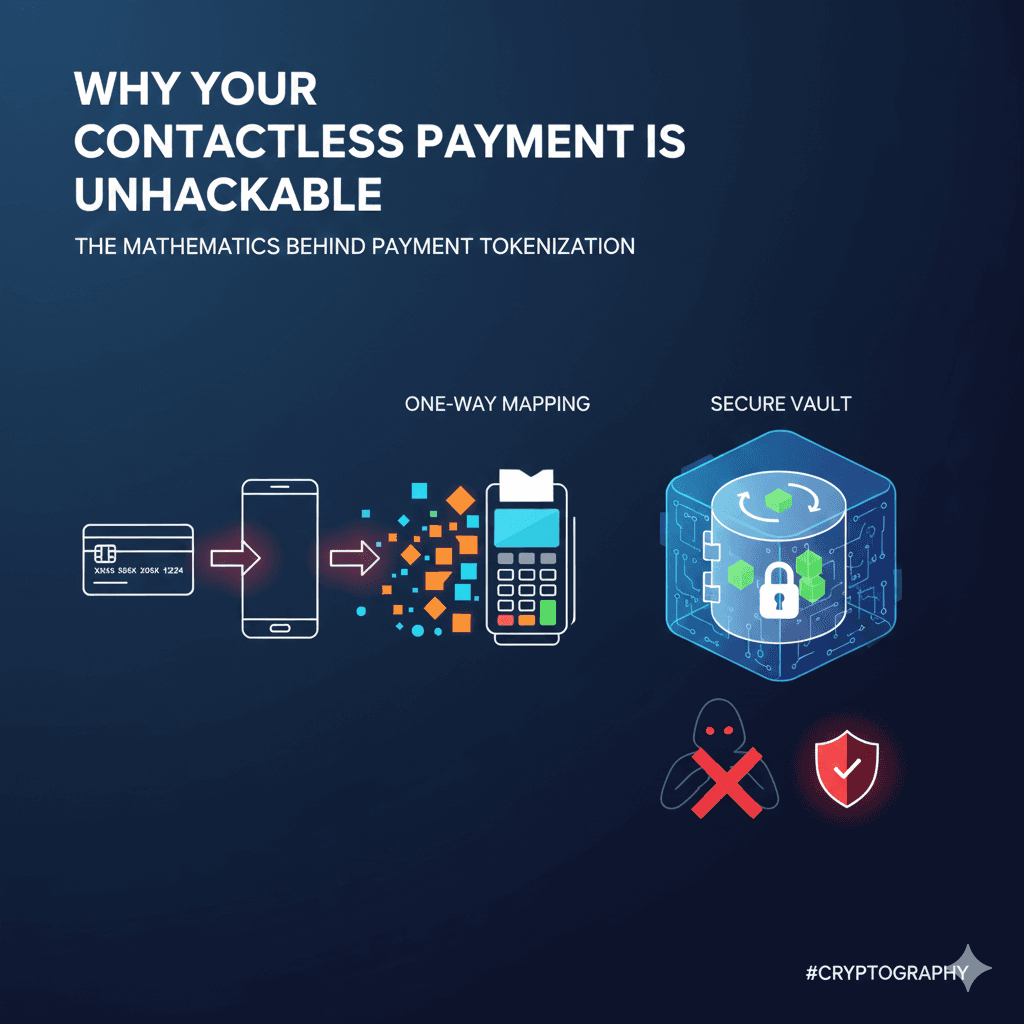
Instead, your card generates a completely different number a token that's basically useless to anyone who intercepts it. And here's the clever part: there's no "decryption key" that turns it back into your real card number. The token and your actual card number aren't connected by any mathematical formula that can be reversed.
Think of it like this: Encryption is locking your front door. Tokenization is having a completely different address that only the post office knows leads to your house.
This isn't my theory it's straight from the technical documentation published by EMVCo, the organization that sets global payment standards. Researchers Francisco Corella and Karen Lewison put it clearly in their 2014 analysis: the token isn't created by encrypting your card number, it's a randomly generated substitute with no mathematical relationship to the original.
What Actually Happens When You Tap
Every single time you tap your card, something interesting happens inside that little chip. Let me break down the entire architecture from start to finish, because once you see how all these pieces fit together, you'll understand why this system is so hard to break.
The Complete Transaction Architecture
Step 1: The Wake-Up (NFC Power Transfer)
When you bring your card within about 4cm of the terminal, something cool happens the terminal is constantly broadcasting a radio frequency field (13.56 MHz). Your card literally has no battery, but that RF field induces a tiny electrical current in the card's antenna coil. This powers up the chip just enough to do its job.
Terminal RF Field
Broadcasting at 13.56 MHz
Card Antenna Coil
Generates ~5 microamps of current
Card Chip Powers On
Ready to process transaction
Step 2: The Handshake
The terminal and your card have a quick conversation:
"Hey, what payment apps do you have?"
"I've got Visa/Mastercard, here's my info"
"Cool, let's use that. Here's the transaction data"
This handshake includes:
Step 3: Inside the Secure Element (The Magic Happens)
Now here's where it gets wild. Your card's chip has a secure element think of it as a tiny vault inside the chip. According to Akter's 2017 research, this is where all the secret keys live, and they NEVER leave.
The chip now has everything it needs:
DATA IT KNOWS (Public):
- •Transaction amount: $4.50
- •Merchant ID: STARBUCKS_NYC_5TH_AVE
- •Unpredictable number from terminal: A7F3B2C8
- •Current timestamp
- •Application Transaction Counter (ATC): 1,547 (this is transaction #1,547 on this card)
DATA ONLY IT KNOWS (Secret - stored in secure element):
- •Card's real PAN (Primary Account Number): 4532 1234 5678 9000
- •Master Key: K_MASTER (unique to this card)
- •Derived Keys: K_ENC, K_MAC (calculated from master key)
- •Card Verification Value (CVV for chip): Different from the one printed on your card
Step 4: Token Generation
Here's the first layer of protection. The chip generates a token using what's called "Format-Preserving Encryption":
INPUT
OUTPUT
This token looks like a card number (16 digits, passes basic validation) but it's completely different. The algorithm is one way you can go from PAN → Token, but not Token → PAN without the master key.
Step 5: Cryptogram Generation (The Unbreakable Part)
Now comes the second layer. The chip creates what's called an ARQC (Authorization Request Cryptogram). This is where the real security magic happens.
INPUTS
ALGORITHM: AES-128 or Triple-DES
OUTPUT
This cryptogram is unique to THIS transaction. Even if you buy another $4.50 coffee at the same Starbucks one second later, the cryptogram will be completely different because:
- •ATC is now 1548 (not 1547)
- •Terminal generates new unpredictable number
- •Timestamp has changed
- •New random elements in the algorithm
Step 6: The Data Package
The card sends this package wirelessly to the terminal:
TRANSMITTED DATA (over NFC)
Notice what's NOT in there:
Step 7: The Journey to Your Bank
Now this data package travels through multiple systems:
Step 8: Bank Validation (The Security Check)
Your bank now does the heavy lifting:
CRYPTOGRAM CHECK
COUNTER CHECK
ACCOUNT CHECK
FRAUD DETECTION (AI/ML)
Step 9: The Response Journey
Your bank sends back approval with its own cryptogram:
Total time for all of this? About 0.3 seconds.
The Multi-Layer Encryption Architecture
What's brilliant is that there are multiple encryption layers, each protecting different things:
Secure Element
- ✓Hardware encryption
- ✓Keys never leave the chip
- ✓Tamper-resistant (self-destructs if opened)
Token Generation (FPE - Format Preserving Encryption)
- ✓One-way function
- ✓PAN → Token (easy)
- ✓Token → PAN (impossible without vault)
Cryptogram (AES-128 or 3DES)
- ✓Unique per transaction
- ✓Includes MAC for integrity
- ✓Time-limited validation
NFC Protocol Encryption
- ✓Encrypted communication channel
- ✓Short range (4cm) limits interception
Network Transport (TLS 1.3)
- ✓End-to-end encryption
- ✓Certificate validation
- ✓Perfect forward secrecy
Token Vault Security
- ✓HSM (Hardware Security Module)
- ✓FIPS 140-2 Level 3 certified
- ✓Multi-party authentication
- ✓Geographically distributed
🔒 An attacker would need to break through ALL six layers simultaneously. Breaking one doesn't help you need them all.
Why This Architecture Is Genius
Here's what blew my mind about this whole system:
It's stateless for the merchant:
Starbucks never sees your real card number, never stores anything reusable, and has minimal PCI compliance burden.
It's deterministic for the bank:
Given the same inputs and keys, the cryptogram calculation is always the same. So the bank can independently verify without any back-and-forth with your card.
It's impossible to replay:
The counter ensures every transaction is unique and ordered.
It's resistant to man in the middle attacks:
Even if someone intercepts everything, they can't modify it (MAC verification fails) or reuse it (counter mismatch).
It works offline (sometimes):
For small amounts, the card can approve transactions even without reaching your bank, using risk management built into the chip.
According to research published by Akter and colleagues in 2017, this architecture has been tested against every attack vector researchers could think of and the fundamental design has held up.
I Tried to Break It (On Paper)
So I thought, okay, what if I'm a hacker and I capture, say, 1,000 transactions from the same card? Surely I could find a pattern, right?
Researchers at MIT's Computer Science department actually studied this in 2018. The short version: no, you can't.
Here's why: the token generation includes secret keys that are buried inside your card's chip. These chips are built to be tamper-resistant if you try to physically open one, it detects the tampering and erases the keys. We're talking serious hardware security here.
A 2021 study by Al-Maliki and Al-Assam in the Information Security Journal went into detail about how these secure elements work. They're designed to self-destruct if someone tries to extract the keys, even with sophisticated equipment.
Without those secret keys, you're basically trying to solve a math problem where half the equation is missing. It doesn't matter how many examples you have you still can't solve it.
But Wait, Don't Hackers Always Find a Way?
This is where it gets interesting. Yes, attackers have tried. Extensively.
The ESET security team published a threat report earlier this year showing that NFC-related attacks have increased 35 times. Sounds scary, right? But here's the thing they're not breaking the tokenization itself. They're using social engineering, tricking people into installing malware, or exploiting sloppy implementations by specific companies.
The actual mathematics protecting the token? Still solid after more than a decade of researchers trying to crack it.
Financial cryptography researcher Martin Emms and his team at Newcastle University spent years analyzing these systems. They found some specific vulnerabilities in how certain cards handled PIN verification, but the core tokenization held up.
The Secret Vault Nobody Talks About
So if these tokens can't be "decrypted," how do legitimate transactions work?
Visa and Mastercard (they launched nearly identical systems in 2014 Visa Token Service and Mastercard Digital Enablement Service) maintain what are basically ultra-secure vaults. When a token comes through, their systems look it up in these vaults to see which real card it corresponds to.
The U.S. Payments Forum explained in their 2019 primer that these vaults run in Hardware Security Modules basically specialized computers designed specifically for security. They're certified to FIPS 140-2 Level 3, which is serious government-grade protection. We're talking multi-person authentication, constant monitoring, and physical security that would make a bank jealous.
Even employees at Visa can't just casually look up a token. Every access is logged, requires multiple approvals, and triggers alerts.
Does This Actually Work in the Real World?
Honestly? The data is pretty compelling.
The Nilson Report tracks payment fraud globally, and they've documented a 67% drop in digital payment fraud since tokenization became widespread in 2020. That's not a small improvement that's a fundamental shift.
McKinsey's 2025 Global Payments Report found another interesting stat: tokenized cross-border payments have 47% fewer compliance holds. So you're getting better security AND faster transactions.
The Smart Card Alliance estimated that payment-related breaches cost about $1.7 trillion globally last year. Tokenization is one of the main reasons that number isn't higher.
What About Quantum Computers?
I know someone's thinking this, so let me address it: won't quantum computers break all this?
Eventually, maybe. But we're talking 10-20 years minimum before quantum computers are powerful enough, and the payment industry is already working on quantum-resistant algorithms. NIST (the National Institute of Standards and Technology) just released post-quantum cryptography standards in 2024.
Plus, the type of encryption used in tokenization (AES) is significantly more resistant to quantum attacks than other common encryption methods. The systems will be upgraded long before quantum computers become a real threat.
Why This Matters
Look, I'm not saying the system is perfect. A recent comprehensive review by Ajisegiri and colleagues in 2024 pointed out that new attack methods keep emerging. Security is an ongoing arms race, not a solved problem.
But what struck me while researching this is how much sophisticated mathematics is protecting that casual coffee purchase. When you tap your card:
- •Your chip is doing cryptographic calculations that would take a supercomputer millions of years to reverse
- •Secret keys that have never left your card are being used
- •A unique, one-time code is being generated
- •Multiple secure systems are working together to validate everything
- •And nobody not the merchant, not someone nearby with an NFC reader, not even hackers who break into databases can get your real card number from the token
The person behind me in that coffee shop was worried about the wrong thing. The real magic isn't in what could go wrong it's in how much is going right, invisibly, every single time.
Next time you tap your card, take a second to appreciate that you're using one of the most elegant applications of modern cryptography in everyday life. The math is protecting you, and it's doing a pretty incredible job.
Sources u can get more information from:
- •EMVCo Payment Tokenisation Specification (2014)
- •Al-Maliki & Al-Assam, Information Security Journal (2021)
- •Akter et al., Proceedings of ARES (2017)
- •Smart Card Alliance, Payment Fraud Prevention White Paper (2014)
- •Corella & Lewison, EMV Tokenisation Analysis (2014)
- •U.S. Payments Forum, Tokenization Primer (2019)
- •Ajisegiri et al., NFC Cyber Threats Review, PMC (2024)
- •ESET Threat Report H1 (2025)
- •Emms et al., Financial Cryptography (2013)
- •Kumar et al., Computer Communications (2019)
- •McKinsey Global Payments Report (2025)
- •MIT Computer Science NFC Security Analysis (2018)
Have you ever worried about tap-to-pay security? Or am I the only one who goes down these research rabbit holes? Drop a comment I'd love to hear what security topics you're curious about.