The Hidden Radio Inside Your Pocket: Why Your Phone Can't Access Its Own Hardware
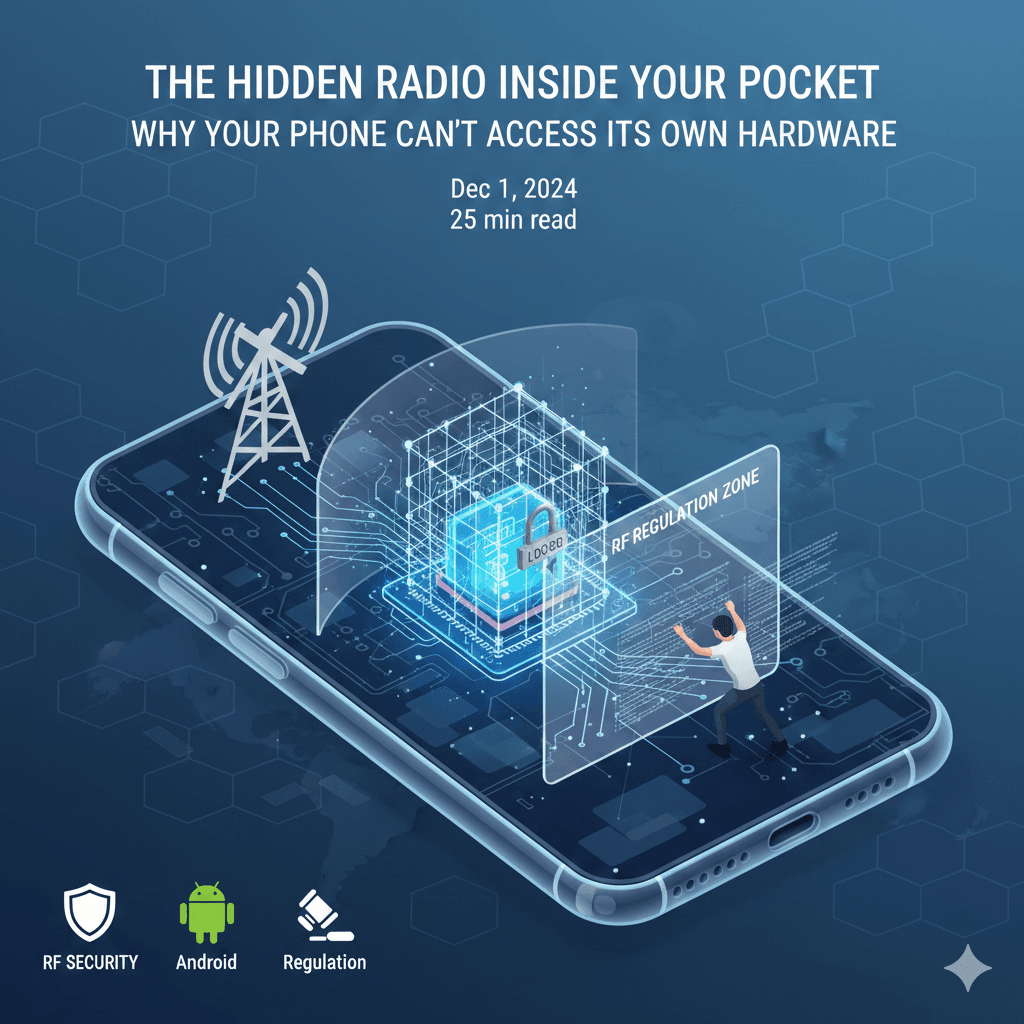
A deep technical exploration of RF hardware lockdown, regulatory compliance, and the architecture preventing custom wireless transmission on modern smartphones.
Your Google Pixel 9 Pro contains some of the most sophisticated radio frequency (RF) hardware ever created. With its Tensor G4 chip, it can simultaneously communicate across dozens of frequency bands from 5G millimeter wave at 39 GHz to Bluetooth Low Energy at 2.4 GHz, NFC at 13.56 MHz, and Ultra-Wideband (UWB) at 6-9 GHz.
Yet, despite having this powerful transmitter in your pocket, you cannot write an app that transmits even the simplest custom RF signal. This article explores the technical, regulatory, and architectural reasons why modern smartphones are "locked down" at the radio level.
Part 1: The RF Hardware Architecture
Inside the Pixel 9 Pro's RF System
The Pixel 9 Pro's wireless capabilities are powered by several specialized chips working in a carefully isolated architecture:
Google Tensor G4 SoC
- •Android OS
- •Apps & Framework
- •Baseband firmware
- •Protocol stacks (5G/LTE/3G)
RF Front-End Modules (RFFEs)
Power Amplifiers & Filters
Notice the separation between the application processor (where your apps run) and the modem processor (which controls the radios). This architectural separation is the first line of defense against custom RF transmission.
The Firmware Barrier
Each RF chip runs proprietary firmware that is cryptographically signed and verified during boot. This creates an impenetrable barrier that prevents any unsigned code from running on the RF hardware.
WiFi/Bluetooth Chip Firmware Authentication
// Simplified firmware authentication flow
struct firmware_header {
    uint32_t magic;              // 0x57434E37 ("WCN7")
    uint32_t version;
    uint32_t code_size;
    uint8_t  signature[256];     // RSA-2048 signature
    uint8_t  cert_chain[2048];   // X.509 certificate chain
};

int verify_firmware(struct firmware_header *fw) {
    // 1. Verify certificate chain roots to OEM key
    if (!verify_cert_chain(fw->cert_chain, OEM_ROOT_KEY)) {
        return -EPERM;  // Unsigned firmware rejected
    }

    // 2. Verify firmware signature
    if (!rsa_verify(fw->signature, fw_data, OEM_PUBLIC_KEY)) {
        return -EINVAL;
    }

    // 3. Check version rollback protection
    if (fw->version < get_min_version_from_fuses()) {
        return -EVERSION;  // Rollback attack prevented
    }

    return 0;
}Part 2: Regulatory Enforcement Architecture
The FCC Equipment Authorization System
Before any phone can be sold in the US, it must pass FCC certification under Part 15 (unlicensed devices). This creates a multi-layered regulatory enforcement system built directly into the hardware and firmware.
Layer 1: Hardware Registers (Non-Volatile Memory)
Regulatory restrictions are burned into the chip at manufacturing time and cannot be modified:
// Burned into chip at manufacturing
        struct regulatory_domain {
          char country_code[2];        // "US", "EU", "JP", etc.
          uint32_t allowed_channels;   // Bitmask of legal channels
          int8_t max_power_dbm[40];    // Per-channel power limits
          uint32_t flags;              // DFS required, Indoor only, etc.
};Layer 2: Firmware State Machine
Firmware enforces checks on every transmission attempt:
Layer 3: Driver-Level Enforcement
The Linux kernel driver provides an additional layer of regulatory checks, including SAR (Specific Absorption Rate) limits to protect human health.
The result: Even if you could somehow bypass one layer, the other layers would still block any unauthorized transmission. The system is designed with redundant enforcement at every level.
The Seven Layers of RF Lockdown
Your Pixel 9 Pro is locked down at seven distinct layers. To transmit a custom RF signal, you would need to defeat ALL seven layers simultaneously which is effectively impossible:
Android Permission System
No custom RF APIs exist
HAL Restrictions
Protocol enforcement at hardware abstraction layer
Driver/Kernel Enforcement
Regulatory checks in nl80211 driver
Firmware Signature Verification
Cryptographic authentication (RSA-2048/4096)
Baseband Processor Isolation
Separate security domain with Secure Element
Hardware Security (Titan M2)
Root of trust with tamper resistance
Physical RF Filters
Hardware bandpass filters block out-of-band signals
🔒 Each layer independently enforces FCC/regulatory compliance, carrier requirements, security policies, and protocol standards.
Why Even Root Access Doesn't Help
Many technically-minded users assume that gaining root access would give them control over the RF hardware. Unfortunately, that's not how modern smartphone security works.
The Titan M2: Hardware Root of Trust
The Pixel 9 Pro's Titan M2 chip enforces security even against root access. It's a separate processor that operates independently of Android:
✅ What root access DOES allow:
- •Flash custom ROM
- •Gain root access in Android
- •Modify system partition
❌ What root access DOESN'T allow:
- •Modify vendor partition (contains HAL)
- •Modify firmware blobs (signed by Google)
- •Modify modem firmware (separate secure boot)
- •Bypass RF restrictions (enforced by firmware)
- •Pass SafetyNet/Play Integrity checks
The Titan M2 chip stores cryptographic keys in tamper-resistant hardware. If it detects any attempt to extract these keys, it self-destructs. This same chip verifies firmware signatures and enforces rollback protection.
What About Software Defined Radio?
Interestingly, you CAN do custom RF transmission with your phone just not using the phone's built-in radios. A $300 HackRF One connected via USB-C gives you complete RF control:
✅ External SDR (HackRF One)
- •Open-source firmware
- •No regulatory enforcement in hardware
- •Direct access to RF transceiver
- •User accepts legal responsibility
❌ Phone's Built-in Radios
- •Closed firmware with signature verification
- •Multi-layer regulatory enforcement
- •No API for raw RF access
- •Manufacturer liable for regulatory violations
The fundamental difference: With an SDR, YOU are legally responsible for compliance. With a phone, the MANUFACTURER is responsible so they lock down the hardware to prevent any possibility of violation.
Key Takeaways
Your phone is more capable than your apps can access
The hardware can do far more than the software allows.
Restrictions are by design, not limitation
Manufacturers intentionally lock down RF to comply with regulations and limit liability.
Root access is not enough
Firmware, bootloaders, and hardware security chips enforce restrictions independently of Android.
Regulatory compliance is multi-layered
From international law to carrier requirements to device certification, restrictions come from many sources.
The gap is widening
New technologies like WiFi 7, 5G Advanced, and eSIM introduce even more restrictions and remote control.
External SDR hardware remains the only option
For custom RF transmission, you need separate hardware that doesn't have these restrictions.
The sophisticated radio in your pocket represents an incredible engineering achievement not just in its capabilities, but in how thoroughly it's been locked down. This multi-layered security architecture protects both users and manufacturers, ensuring that the powerful RF hardware can only be used in ways that comply with global regulations and safety standards.
References & Further Reading:
Official Documentation:
- •FCC Part 15 Regulations: https://www.ecfr.gov/current/title-47/chapter-I/subchapter-A/part-15
- •Wi-Fi Alliance Certification: https://www.wi-fi.org/certification
- •3GPP Specifications: https://www.3gpp.org/specifications
- •Android HAL Documentation: https://source.android.com/docs/core/architecture/hal
Technical Papers:
- •"Shannon Baseband Security Analysis" - Comsecuris Research
- •"Titan M: Google's Security Chip" - Google Security Blog
- •"Android Verified Boot 2.0" - AOSP Documentation
- •"OpenRAN Security Considerations" - O-RAN Alliance
Legal Resources:
- •FCC Equipment Authorization Database: https://fccid.io
- •ITU Radio Regulations: https://www.itu.int/pub/R-REG-RR
- •ETSI Harmonized Standards: https://www.etsi.org
Legal Disclaimer
This article is for educational purposes only. Modifying device firmware or transmitting on unauthorized frequencies is illegal and may result in significant fines or criminal penalties. Always comply with local regulations regarding RF transmission.
Did this deep dive into smartphone RF architecture surprise you? What other technical topics would you like to see explored? Let me know in the comments below.