Why Do People Do ‘Crazy’ Things?
It's not just loose rules or moral failure. Behind every extreme act lies a web of unmet needs, broken self-worth, social inequality, and a future that feels impossible to plan for.
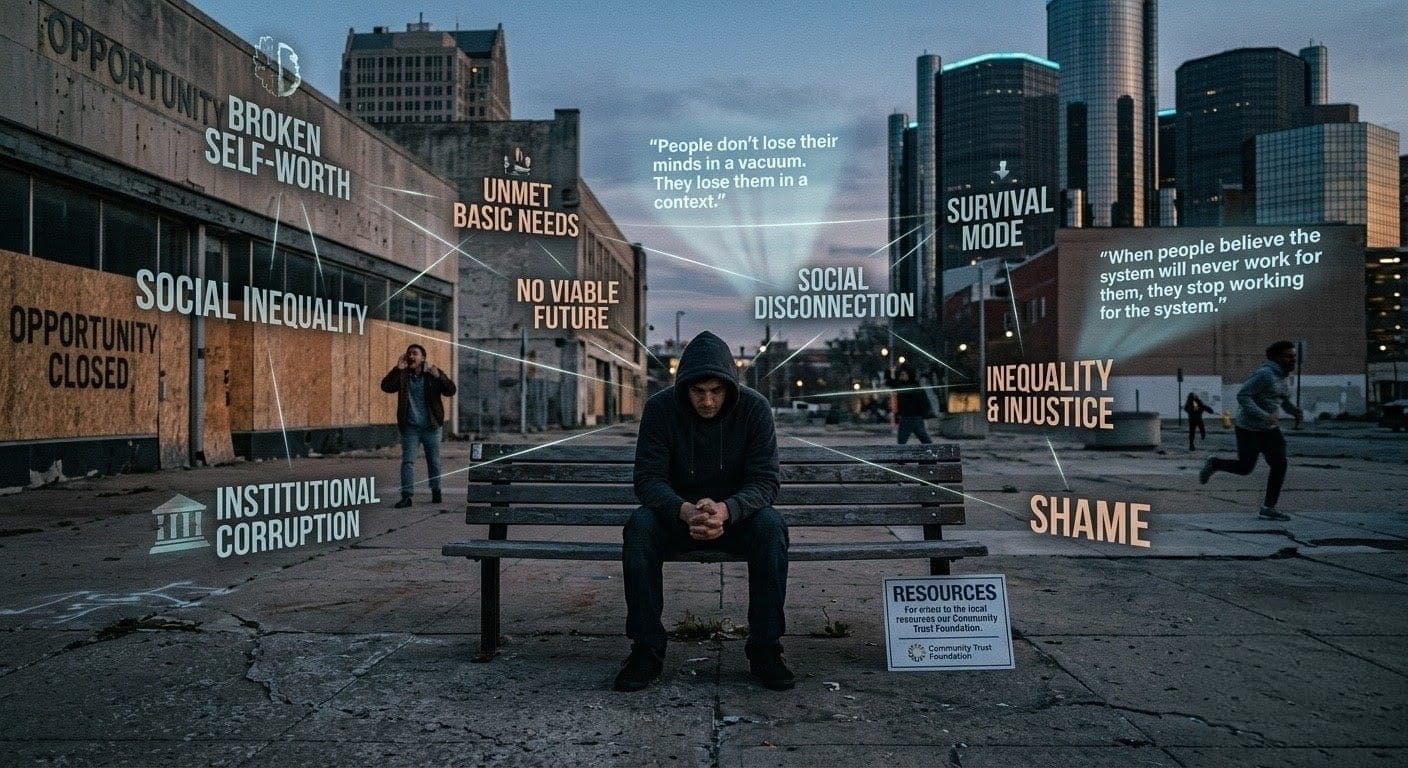
When we witness someone doing something that seems irrational dangerous, destructive, or self-sabotaging our first instinct is often to judge. “They must be crazy.” “There are no rules anymore.” But psychology and social science tell a far more complex and compassionate story.
Human behavior, even at its most extreme, is almost never random. It is a response to internal pain, to social conditions, to a world that has repeatedly communicated to someone that they do not matter.
“People don't lose their minds in a vacuum. They lose them in a context.”
Is it really about loosened rules?
Many people blame extreme behavior on the erosion of social norms fewer rules, less discipline, less respect for authority. And while social structure does shape behavior, this explanation alone is dangerously incomplete.
Rules only work when people feel they have something to lose by breaking them. When someone sees no future, feels no belonging, and holds no self-worth, external rules lose their grip. You cannot scare someone into compliance who already feels they have nothing. Compliance is rooted in hope and hope requires a system that seems fair and reachable.
Research consistently shows that crime, self-destruction, and social deviance spike not just when rules are absent, but when inequality is high and social trust collapses regardless of how strict the laws are.
Six psychological and social roots
No sense of self-worth
When a person genuinely believes they have no value, self-preservation weakens. Risky and destructive behavior becomes easier there is nothing to protect.
Inequality & injustice
Feeling permanently below others in wealth, status, or opportunity generates deep shame and rage. Extreme acts can feel like the only way to restore a sense of power.
Unmet basic needs
Maslow's hierarchy isn't just theory. People who lack food, safety, shelter, or belonging operate in survival mode and survival mode overrides long-term rational thinking.
No viable future
Planning requires hope. When every path forward seems blocked by poverty, discrimination, or a broken system the future shrinks to the present moment only.
Institutional corruption
When governments, institutions, and systems are visibly corrupt, people lose faith in legitimate pathways. Why follow rules that the powerful openly ignore?
Social disconnection
Isolation is not just uncomfortable it is clinically dangerous. Disconnected people are far more vulnerable to radicalization, addiction, and impulsive extremism.
The crisis of feeling worthless
Self-worth is not vanity. It is the psychological foundation that allows a person to make decisions with a long-term perspective. When someone genuinely believes they are worthless not just as a passing thought, but as a deep conviction they stop naturally weighing consequences. The question “what will this cost me later?” only matters if you believe you have a “later” worth protecting.
This is why shame is one of the most dangerous human emotions. Psychologist Brené Brown's research shows that shame unlike guilt is not about what you did, but who you are. And when a society constantly signals to certain groups that they are inferior, dispensable, or unworthy, it plants seeds of shame that can eventually explode outward or inward.
When the system feels rigged
Social psychologists have studied what happens when people feel the playing field is permanently unfair. The results are consistent: people in highly unequal societies show higher rates of mental illness, violence, addiction, and distrust regardless of their absolute wealth level.
It is not poverty alone that breaks people. It is the combination of poverty and the daily visibility of extreme wealth nearby. Inequality is not just an economic condition it is a psychological injury. It communicates, constantly, that some lives are worth more than others.
“When people believe the system will never work for them, they stop working for the system.”
Survival mode hijacks rational thinking
Neuroscience has confirmed what Maslow described decades ago: when the brain is operating under conditions of deprivation hunger, fear, unsafe housing, chronic stress the prefrontal cortex (responsible for planning, judgment, and impulse control) becomes effectively suppressed. The brain shifts to the limbic system, which governs fight-or-flight responses.
In other words, a person who is constantly struggling to survive is literally working with reduced access to the parts of the brain that make careful, long-term decisions. This is not weakness of character. It is neurobiology. Blaming someone in survival mode for “bad choices” is like blaming someone running from a fire for not checking the weather forecast.
When the future is stolen by the system
One of the most psychologically devastating forces in a society is visible, unpunished corruption. When people watch politicians steal openly, when justice is only for those who can afford it, when every institution seems captured by self-interest it does something profound to the human psyche.
It destroys what psychologists call future orientation the ability to delay gratification and plan ahead. Why save money in a system that devalues your currency? Why build a career in a sector that rewards connections over merit? Why follow the law when those who write the laws break them freely? Corruption doesn't just steal money. It steals the psychological architecture of hope.
Studies on countries with high corruption perception scores consistently show lower rates of civic trust, higher rates of psychological distress, and a tendency toward short-termism and risk-taking across the population not just among individuals directly harmed by corruption.
A call for understanding, not excuses
None of this is to excuse harmful behavior. People still bear responsibility for their actions. But understanding why people reach breaking points is not about giving them a pass it is about building societies that don't produce so many breaking points in the first place.
The “crazy” person is often a person who ran out of options, ran out of hope, and ran out of reasons to believe the normal path would ever work for them. Address the self-worth crisis. Reduce inequality. Meet basic needs. Fight corruption. Rebuild social trust. The behavior will follow not because people changed, but because the conditions that produced the behavior changed first.